
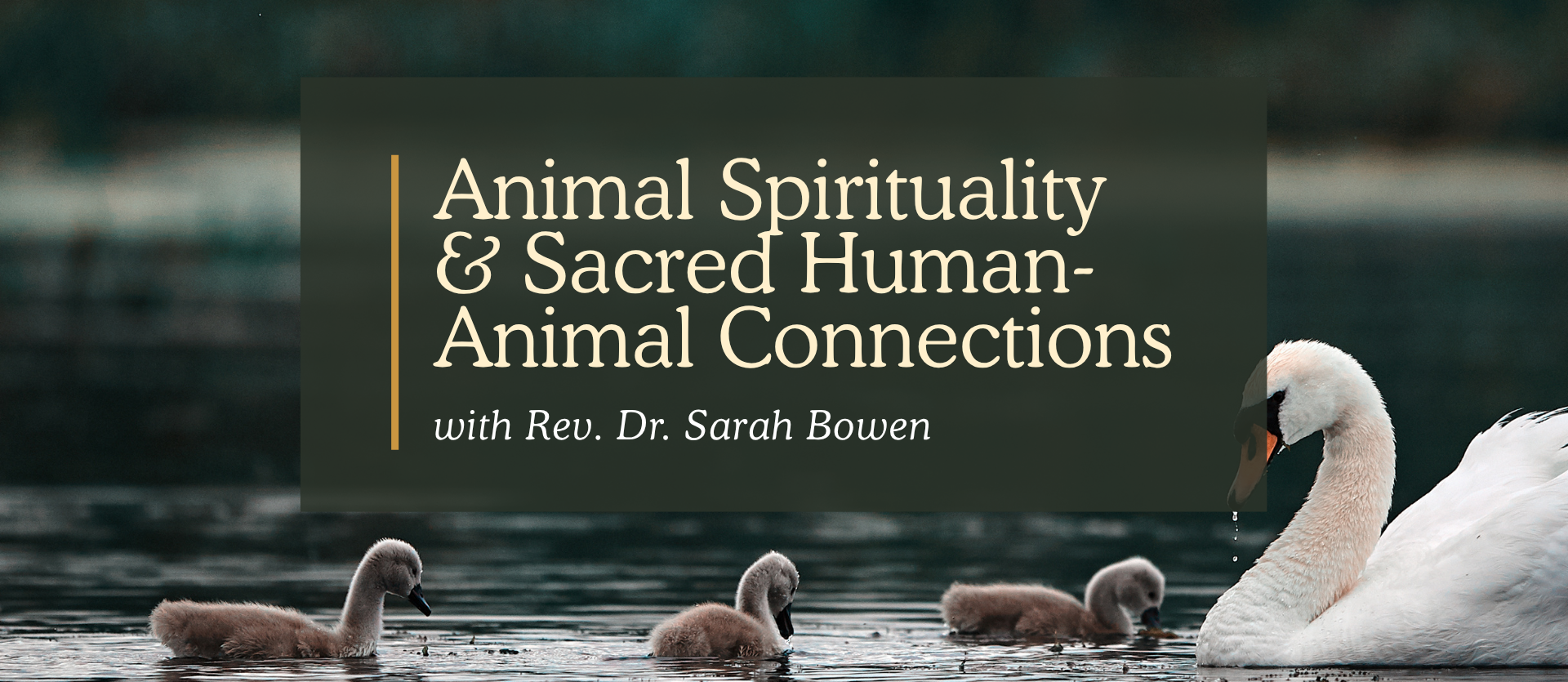
Jane Goodall, Animal Theology, and the Animals We Each Know
Do Animals Have Spiritual Lives?
If you've ever loved an animal, you've probably wondered what they understand, what they feel, and how they experience the world.
Jane Goodall spent decades observing chimpanzees and documenting behaviors that challenged long-held assumptions about the differences between humans and other animals. Her observations of grief, social bonds, and apparent awe raise questions that science alone cannot fully answer.
Could animals have spiritual lives of their own? And what might that mean for the relationships we share with them?
Join the Rev'd Dr. Sarah A. Bowen for an exploration of animal spirituality through the work of Jane Goodall, contemporary animal research, and theology.
Together, we'll examine what we know about animal emotion and consciousness, question inherited beliefs about human uniqueness, and explore practical ways to honor the spiritual significance of human–animal relationships.
Whether you're a minister, a spiritual companion, or someone whose life has been shaped by an animal, you'll find space to consider these questions without being asked to adopt a particular belief.
Saturday, March 6, 2027
12 PM – 5 PM ET
Live on Zoom · Recording included
General Public $160 · OSLA Affiliated Alumni $125
What We'll Explore
Jane Goodall and the Inner Lives of Animals
Jane Goodall's observations of chimpanzees helped transform scientific understanding of animal behavior. Her work documented complex social relationships, emotional expression, grief, and behaviors that some observers interpret as experiences of awe.
We'll explore her discoveries alongside research from other primatologists and scientists studying animal consciousness, communication, emotion, and culture.
We'll also consider the limits of what these observations can tell us. Animal behavior may suggest rich inner experiences, but interpreting those experiences requires care, especially when we begin asking questions about spirituality.
Animal Theology and the Sacred Beyond Humanity
Many religious traditions have placed human beings at the center of spiritual life. Animal theologians challenge us to examine that assumption and reconsider how we understand consciousness, sacredness, and our relationships with other species.
We'll explore different theological perspectives on animals and consider how spiritual traditions define experiences that may not be exclusively human.
The workshop doesn't seek to establish whether animals are spiritual. Instead, it offers a thoughtful exploration of what we mean by spirituality and how our understanding might change when we take other animals seriously.
The Beliefs That Shape Our Relationships With Animals
Our relationships with animals are influenced by family, culture, religion, and the societies in which we live.
Some animals are considered family members, while others are understood primarily as food, property, labor, research subjects, or wildlife.
We'll examine how these distinctions reflect assumptions about human importance and the value of other species.
We'll also explore anthropocentrism, speciesism, and environmental racism, considering how power shapes which animals and human–animal relationships receive recognition, protection, and care.
The Spiritual Significance of the Human–Animal Bond
For many people, animals are central to family life, emotional well-being, and spiritual experience.
A beloved animal may be a companion through illness, a source of comfort during difficult times, or part of someone's understanding of love and the sacred.
Yet these relationships are not always recognized in spiritual communities. People may struggle to find language for their experiences or feel that their grief and attachment are misunderstood.
We'll explore ways to listen more attentively, ask respectful questions, and acknowledge the importance of these relationships without making assumptions about what they mean to another person.
Making Room for Animals in Spiritual Practice and Ministry
We'll consider how prayer, meditation, contemplative nature practices, and simple rituals can acknowledge our relationships with other species.
For ministers and spiritual caregivers, we'll explore inclusive language and liturgical considerations for multispecies families and communities. These practices require attention not only to human spiritual needs but also to animals' comfort, agency, and participation.
We'll also discuss the boundaries of appropriate spiritual care, including when someone may benefit from referral to a professional with specialized training.
What You'll Take Away
A Grounded Understanding of Animal Spirituality
Explore what scientific research and theological perspectives suggest about animal emotion, consciousness, and spiritual possibility, while recognizing what remains uncertain.Greater Awareness of Your Own Beliefs
Reflect on how your religious, cultural, and personal experiences have shaped your understanding of animals and their place in spiritual life.More Inclusive Ways to Speak About Animals
Develop language that acknowledges meaningful human–animal relationships without imposing a particular theological interpretation.Practical Listening and Spiritual Care Skills
Practice asking open-ended questions and responding thoughtfully when people describe the importance of animals in their lives.Interspecies Spiritual Practices
Experience prayer, meditation, and contemplative practices that encourage attentiveness to other animals and the natural world.Resources for Continued Learning
Receive a digital resource guide with recommended readings and videos, reflection prompts, interspecies spiritual practices, and liturgical ideas.
You'll also gain a clearer understanding of the limits of general spiritual care and when specialized support may be appropriate.
How We’ll Learn Together
The Rev’d Dr. Sarah Bowen brings scientific research, theology, and practical spiritual care into conversation through a combination of short presentations, guided reflection, and experiential learning.
We'll engage with selected observations from Jane Goodall and other scientists, using photographs, brief videos, animal vocalizations, and natural soundscapes to help us attend more closely to the lives of other species.
During the workshop, you'll have opportunities to:
Examine scientific research on animal emotion, cognition, consciousness, and behavior.
Discuss theological perspectives that challenge human-centered assumptions about spirituality.
Reflect on meaningful relationships with animals in your own life.
Practice listening across different beliefs and experiences.
Participate in prayer, meditation, and contemplative nature-based practices.
Consider inclusive language and rituals for multispecies families and spiritual communities.
Identify practical ways to apply what you've learned in your personal life, community, or ministry.
Pair and small-group conversations will offer opportunities to share experiences and learn from others.
You'll also be invited to try a guided interspecies or nature-based practice beyond the workshop and bring one insight into your own relationships or spiritual community.
No prior study of animal theology or animal behavior is required. Participants are welcome to bring different spiritual beliefs, experiences, and questions.
Who Should Attend?
Lovers of Animals and Spiritually Curious People
If an animal has played an important role in your life, you may have wondered about their emotions, awareness, or capacity for experiences beyond what we can easily explain. This workshop offers an opportunity to explore those questions through scientific research, theological perspectives, and personal reflection.
Ministers, Chaplains, and Spiritual Companions
People often turn to spiritual caregivers during experiences involving animals, including illness, death, family transitions, and questions about the meaning of these relationships. Yet animal spirituality and the human–animal bond receive relatively little attention in traditional ministerial education.
This workshop offers a framework for recognizing these relationships, using more inclusive language, and responding with appropriate care. It is particularly relevant for One Spirit students, graduates, and spiritual care practitioners seeking to broaden their understanding of the people and communities they serve.
Educators, Community Leaders, and Those Interested in Animal Ethics
If your work or interests involve theology, ecology, animal welfare, or community care, this workshop offers an opportunity to consider how our beliefs about animals shape our responsibilities toward them. We'll examine the relationship between spiritual understanding, scientific knowledge, and the ways humans live alongside other species.
If You Are Curious
All are welcome, including One Spirit students and graduates, ministers, spiritual companions, animal caregivers, and people joining our community for the first time. You don't need to follow a particular spiritual tradition, or any at all, to participate. You don’t need to have any scientific framework or background. All that is needed is a desire to explore!
About Your Facilitator
“This workshop brings together fields that are rarely taught in the same room: animal behavior and cognition, theology, spirituality, and practical ministry. Rather than treating animals as a sentimental addition to human spiritual life, it takes their experiences and relationships seriously while remaining careful about what science can and cannot tell us about their inner lives.”
—The Rev.’d Dr. Sarah

The Rev'd Dr. Sarah A. Bowen, DMin, MSc, FOCAE (she/her), is Dean of Discovery at One Spirit Learning Alliance and Founding Director of the Animal Chaplaincy Training program at Compassion Consortium.
An animal theologian, author, educator, and interspecies chaplain, Sarah has helped develop the emerging field of interspecies spiritual care.
Her work addresses the spiritual dimensions of human–animal relationships in settings that include veterinary practices, animal shelters, wildlife rehabilitation, disaster recovery, and multispecies justice movements.
Sarah holds a postgraduate degree in anthrozoology, the interdisciplinary study of human–animal relationships, and a Doctor of Ministry focused on spiritual care involving animals and the human–animal bond.
She is the author of the award-winning Sacred Sendoffs: An Animal Chaplain's Advice for Surviving Animal Loss, Making Life Meaningful, & Healing the Planet (Monkfish Publishing, 2022).
Sarah has received Canisius University's Excellence in Anthrozoology Award, serves on the American Academy of Religion's Animals and Religion Steering Committee, and is a Fellow at the Oxford Centre for Animal Ethics.
Her academic and professional work brings together animal behavior, theology, spirituality, and practical ministry, making research accessible while helping participants consider its relevance to their own lives and communities.
Registration Details
What Your Registration Includes
Five hours of live instruction and discussion with the esteemed Rev'd Dr. Sarah A. Bowen.
Workshop recording, accessible through June 30, 2027.
Exploration of Jane Goodall's work and contemporary research on animal minds.
Theological perspectives on animal spirituality and human–animal relationships.
Guided reflection and interspecies spiritual practices.
Practical approaches to inclusive language and spiritual care.
A digital resource guide with readings, videos, reflection prompts, spiritual practices, and liturgical ideas.
Opportunities for small-group discussion, both inside and outside of the classroom.
Registration Pricing
Public: $160 · OSLA Affiliated Alumni: $125
Taking more than one workshop? Buy 3, save 15%. Buy 4, save 20%!
Discount applied automatically at checkout.OSLA Alumni: Log in to your OSLA Portal to apply your affiliate discount.
Not affiliated yet? Learn More about Affiliation
After You Register
You'll receive a confirmation email with instructions for accessing the workshop's Hylo Course Board, where you'll find the course Zoom link, workshop materials, and additional details for participation.
Can't attend live? The recording will be available within 72 hours of the workshop to the Hylo Course Board.
Questions? Contact help@1spirit.org.